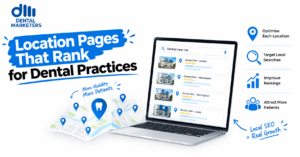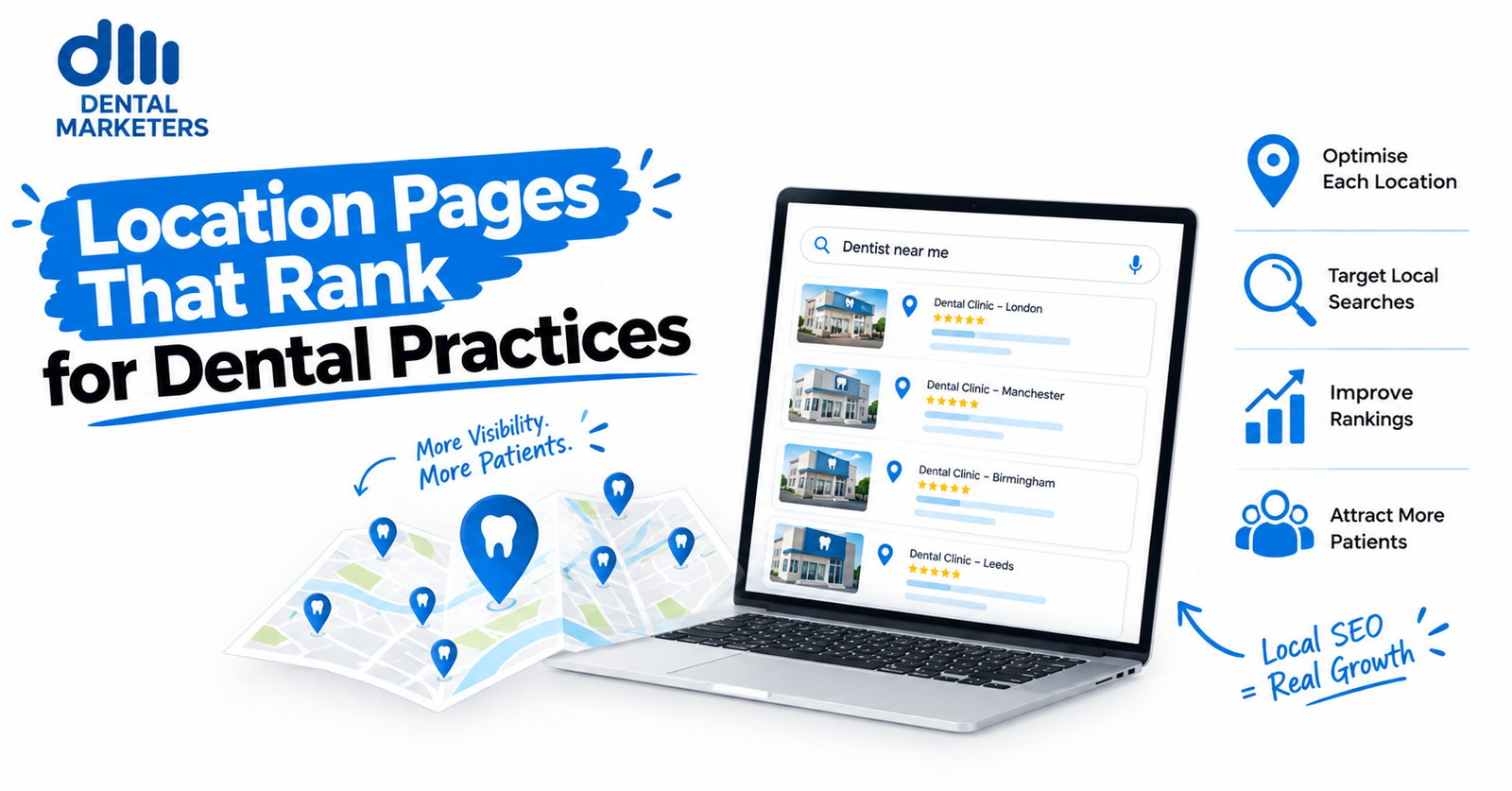
A dental location page is a dedicated web page for one specific practice within a dental group, covering its address, team, services, and hours. Location pages that rank need a genuinely unique introduction, consistent business details matching Google Business Profile, and clear separation from national treatment pages to avoid the two competing for the same search.
One dental group, ten practices, one shared “Locations” page. That single page cannot rank for ten different cities at once. So, each location needs its own page. This guide shows exactly how to structure city and area pages that actually rank, for dental practices of any size.
What Is a Dental Location Page?
A dental location page is a dedicated web page for one specific practice within a larger dental group. It includes the address, opening hours, team, and services for that one site. In short, it gives Google a single, clear page to rank for that particular city or area.
A shared “Locations” page with a list of addresses gives Google one URL to work with for your whole group. That single URL cannot rank for “dentist in Leeds” and “dentist in Bradford” and “dentist in Wakefield” at the same time. Each of those searches needs its own dedicated page.
This is different from a general “Find Us” or “Locations” page listing every address together. A shared list gives Google very little unique content per site. A dedicated page gives Google everything it needs to rank that one location properly.
Why Location Pages Matter for Multi-Location Dental Practices
Every dental practice within a group operates in its own local market. A patient searching in one town has no interest in a practice thirty miles away, however good it is. Because of this, Google needs to match each search to the nearest, most relevant page.
Here is why this matters so much for multi-location dental practices:
- Each practice competes in its own local area, against different competitors
- Google needs a distinct page to match a distinct local search
- A group with ten shared pages competes with one URL, while a rival with ten dedicated pages competes with ten
- Patients searching for a specific city expect to see that city named clearly
- Weak location pages quietly limit growth, even while the practices themselves perform well
As a result, location pages are not a nice extra. They are a genuine structural requirement for any dental group with more than one site. Skip them, and Google simply cannot show the right practice to the right patient.
Picture a dental group with eight practices across Yorkshire. Every practice shares one “Locations” page listing all eight addresses. A patient in Wakefield searches “dentist in Wakefield” and never sees the group at all, despite having a practice five minutes from that patient’s home. A rival with a dedicated Wakefield page appears instead. The practice itself was never the problem. The page structure was.
A location page also protects against a subtler problem. Without one, a patient searching for a specific city may land on your homepage instead, which rarely mentions that city at all. This creates a poor first impression, right when trust matters most.
The Dental Location Page Template
Use this template as the foundation for every location page across your group. The structure stays the same. The content inside it changes per site.
A clear heading with city and service. For example, “Dentist in Leeds” or “Family Dentistry in Headingley.” This tells patients and Google exactly what the page covers.
Full practice details. Name, address, and phone number, shown as real text rather than an image. These details must match your Google Business Profile exactly, down to abbreviations.
An embedded map. A simple Google Maps embed helps both patients and search engines confirm the exact location.
A genuinely unique introduction. Around 100 to 150 words specific to that practice. Mention the town, nearby landmarks, and how long the practice has served the area.
Services offered at that site. Not every practice in a group offers every treatment. List only what is genuinely available at that specific location.
Team details. Names, roles, and a short bio for the dentists and hygienists at that practice. This content is naturally unique to each site.
Opening hours. Shown clearly as text, matching your Google Business Profile.
A clear call to action. A visible way to book, call, or enquire, using that practice’s own phone number.
How to Write Unique Content for Every Location Without Starting From Scratch
Writing genuinely unique pages for ten or twenty practices sounds like a huge task. However, it does not need to be, once you split the work sensibly.
Step 1: Identify what must stay unique. The introduction paragraph and team details fall into this category, since they genuinely differ site by site.
Step 2: Identify what can be shared. Service descriptions can often stay largely the same across every location, with one small local sentence added.
Step 3: Build one shared template. Create the page structure once, then treat each location as a simple content swap.
Step 4: Write one intro at a time. A short, genuinely local paragraph for each site, mentioning the town and nearby landmarks.
Step 5: Roll the template out gradually. Start with your highest-priority locations, then extend the same approach across the rest of the group.
This process keeps quality high without demanding a full rewrite for every single site. A group with twenty practices can realistically work through this process in a few weeks, writing one genuine introduction at a time rather than attempting everything at once.
Avoiding Location Page and Treatment Page Overlap
Location pages should never compete directly with your treatment pages. A national “Invisalign” page explaining the treatment itself is different from an “Invisalign in Leeds” page describing that specific practice.
Keep these two page types working together, not against each other. Let one clear treatment page explain the procedure generally, then link out to each practice offering it locally. This avoids the two pages quietly competing for the same search, a problem that can otherwise undo the benefit of building location pages at all.
Getting this structure right protects both page types, so each one has a genuine chance to rank on its own terms.
Key Benefits of Location Pages That Rank
Getting your location pages right brings clear, lasting rewards. For example:
- Sharper local visibility. Each practice gets a genuine chance to rank in its own town, rather than competing on one shared page.
- Better first impressions. Patients land on a page that clearly matches their search, not a generic homepage.
- Stronger trust signals. Genuine local detail and real team information build confidence before a patient ever calls.
- Protection against internal competition. Clear separation from treatment pages avoids one page undermining another.
- A foundation that scales. A well-built template makes adding new practices far simpler in future.
Altogether, these benefits compound as a dental group continues to grow.
Frequently Asked Questions
What is a dental location page?
A dedicated web page built for one specific practice within a dental group, covering its address, team, services, and hours for that particular site.
Why can’t one shared page work for every location?
A single shared page gives Google only one URL to rank for every town in your group. Each town needs its own dedicated, unique page.
How long should the introduction on a location page be?
Around 100 to 150 words works well. It should mention the town, nearby landmarks, and something genuinely specific to that practice.
Should every location page list the same services?
No. Only list the treatments genuinely available at that specific practice, even within one group.
Can a location page and a treatment page target the same keyword?
They can compete unintentionally if not planned carefully. Keep treatment pages general and location pages local, then link the two together clearly.
How long does a new location page take to rank?
Most new location pages need around two to three months to gain real traction, assuming the rest of the site has reasonable authority already.
Ready to Build Location Pages That Actually Rank?
A shared “Locations” page will only take a growing dental practice so far. Dental Marketers helps multi-location dental groups build genuine, well-structured city and area pages, so every practice gets a fair chance to rank in its own town. Get in touch today, and let’s build a location page structure that scales with your group.
Also read: Avoid Local SEO Cannibalisation Between Locations