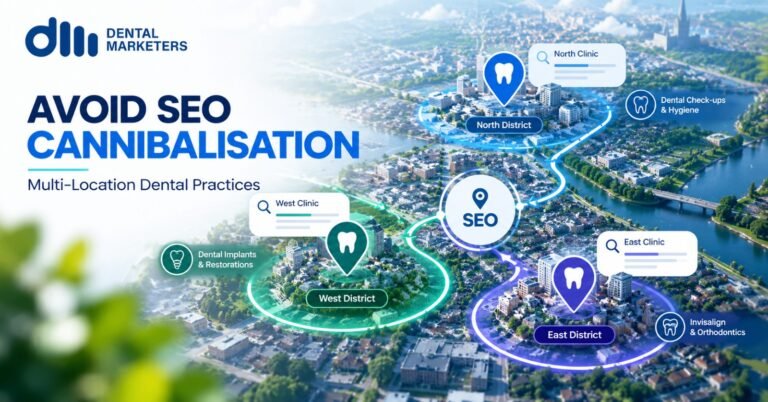
Local SEO cannibalisation between practice locations happens when two or more of a dental group’s own pages compete for the same keyword and location, splitting ranking power between them. Fixing it means mapping every page to one clear keyword, keeping treatment pages and location pages distinct, and linking them together with purpose.
Introduction
Growing a dental group is exciting. However, growth can quietly hurt your own rankings. When two of your own pages compete for the same search, both often lose. This guide shows dental groups exactly how to stop their own locations competing against each other.
What Is Local SEO Cannibalisation Between Practice Locations?
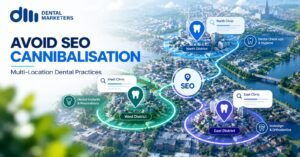
Local SEO cannibalisation between practice locations means two or more of your own pages target the same keyword and location. For example, two nearby branches might both target “dentist near me” for the same town. Or one national treatment page might compete against five separate branch pages for the same procedure.
Cannibalisation is not always obvious straight away. Rankings might simply feel flat, even as your group grows. A quick search for your own main keywords often reveals it, once you know what to look for.
Why This Matters So Much for Dental Groups
Local SEO cannibalisation happens when two or more pages from the same website compete for the same search term. For a dental group, this often means two practice pages, or two treatment pages, fighting for the same ranking spot. In short, your own pages become each other’s biggest competitor.
Dental groups face this risk more than most businesses. Each new location adds another page. Each new treatment page can overlap with pages already live at other branches. Because of this, growth without a clear structure can quietly work against you, even while every branch performs good dentistry.
Here is why this matters so much for dental groups:
- Two competing pages split your ranking signals between them
- Google often struggles to decide which page deserves to rank
- Backlinks and authority get divided, not combined
- Patients may land on the wrong branch’s page entirely
- Growth can feel busy, yet visibility quietly stays flat
As a result, cannibalisation is not really about too little SEO effort. It is usually about too little structure behind a growing group. Skip proper structure, and each new location can start working against the ones before it.
Picture a group with three branches within ten miles of each other. Each branch page uses the same template, with only the town name changed. A patient searching nearby sees all three pages fighting for the same spot. Google cannot easily tell which branch is the best match. Rankings for all three branches stay lower than they should.
Common Causes of Cannibalisation in Dental Groups
Several patterns show up again and again across growing dental groups.
Near-identical location pages. Every branch page uses the same template, with only the town name changed. Google struggles to tell each page apart.
Overlapping service areas. Two branches serve the same town or postcode. Both pages compete for the exact same local searches.
Treatment pages competing with location pages. One central “Invisalign” page competes against several branch-specific Invisalign sections, splitting relevance across the group.
No clear page hierarchy. Nobody has mapped which page should rank for which keyword, so new pages get created without checking for overlap first.
Copied patient content. The same generic patient story or description appears across several branch pages, weakening each one’s uniqueness.
Automated bulk page creation. Location pages generated automatically, from a spreadsheet of town names, rarely include enough genuine local detail to avoid overlap.
How to Avoid Local SEO Cannibalisation Between Practice Locations
Follow this approach to keep every branch page working for the group, not against it.
First, map every page and its target keyword. Build one simple spreadsheet listing every page and the main keyword it should own.
Second, give each branch page a genuinely local identity. Include the branch’s own team, real local detail, and its own specific services.
Third, keep treatment pages and location pages distinct. Let one clear page own each treatment nationally, then link out to the branches offering it.
Fourth, check for overlap before publishing anything new. Search your own site for the target keyword first, to see what already exists.
Fifth, use internal links with purpose. Link from treatment pages to the right branch pages, using natural, local anchor text.
A safe example structure might separate “Invisalign in Manchester” as a distinct branch page, while a single group-wide “Invisalign” page explains the treatment itself and links out to every branch that offers it. Neither page then competes with the other for the same search.
Step-by-Step Guide: Fixing Existing Cannibalisation
Follow these five steps if you suspect cannibalisation is already happening across your group.
Step 1: Search your own site for your main keywords. Note every page that appears for each one.
Step 2: Identify true duplicates. Look for pages that clearly target the exact same search and location.
Step 3: Choose one page to keep as the primary page. Pick the page with the strongest existing rankings or local relevance.
Step 4: Merge or rewrite the weaker page. Either combine its useful content into the primary page, or rewrite it with a genuinely distinct focus.
Step 5: Update internal links to point to the correct page. This tells Google, clearly, which page should win.
Over time, this process consolidates your ranking power. It also makes your whole group easier for patients to navigate correctly.
This process also protects future growth. Once your structure is clear, each new branch can slot in without quietly competing with the ones that came before it. A clear structure also makes it far easier to onboard a newly acquired practice, since you already know exactly where its pages should sit.
Key Benefits of Fixing Cannibalisation
Fixing cannibalisation brings clear, group-wide rewards. For example:
- Stronger local rankings. Each branch page gets a genuine chance to rank in its own local area, without fighting a sibling page.
- Concentrated ranking power. Ranking signals concentrate on one clear page, instead of splitting weakly across several.
- Better patient journeys. Patients land on the correct, most relevant branch page more often, not a confusing duplicate.
- Growth that compounds. New locations grow the group’s visibility, rather than quietly diluting the branches you already have.
- Less guesswork. Your team spends less time wondering why rankings feel flat, even as the group expands.
Altogether, these benefits compound as your group continues to grow.
Frequently Asked Questions
What is local SEO cannibalisation between practice locations?
It happens when two or more pages from the same dental group compete for the same keyword and location, splitting ranking power between them.
Can two branch pages target the same keyword safely?
Only if the branches serve genuinely different areas. If service areas overlap significantly, competition between the pages is very likely.
Should a dental group have one page per treatment, or one per branch?
Ideally both, structured clearly. One page explains the treatment group-wide, while separate branch pages cover it locally, each linked together.
How do I check if my dental group has cannibalisation?
Search your own main keywords directly in Google and note every one of your own pages that appears for each term.
Does merging two competing pages lose existing rankings?
Usually not. Merging often improves rankings overall, once ranking signals combine onto one stronger page instead of splitting.
Is cannibalisation only a problem for large dental groups?
No. Even two branches can create cannibalisation, especially if they sit close together or share overlapping service areas.
Ready to Stop Your Locations Competing With Each Other?
Growth should strengthen your rankings, not quietly work against them. Dental Marketers helps multi-location dental groups build a clear page structure, so every branch supports the group instead of competing with it. Left unstructured, even excellent dentistry can struggle to show up online, simply because your own pages are standing in each other’s way. Get in touch today, and let’s build a structure that lets every location rank on its own merit.
Also read:https://dentalmarketers.co.uk/multi-location-dental-seo/