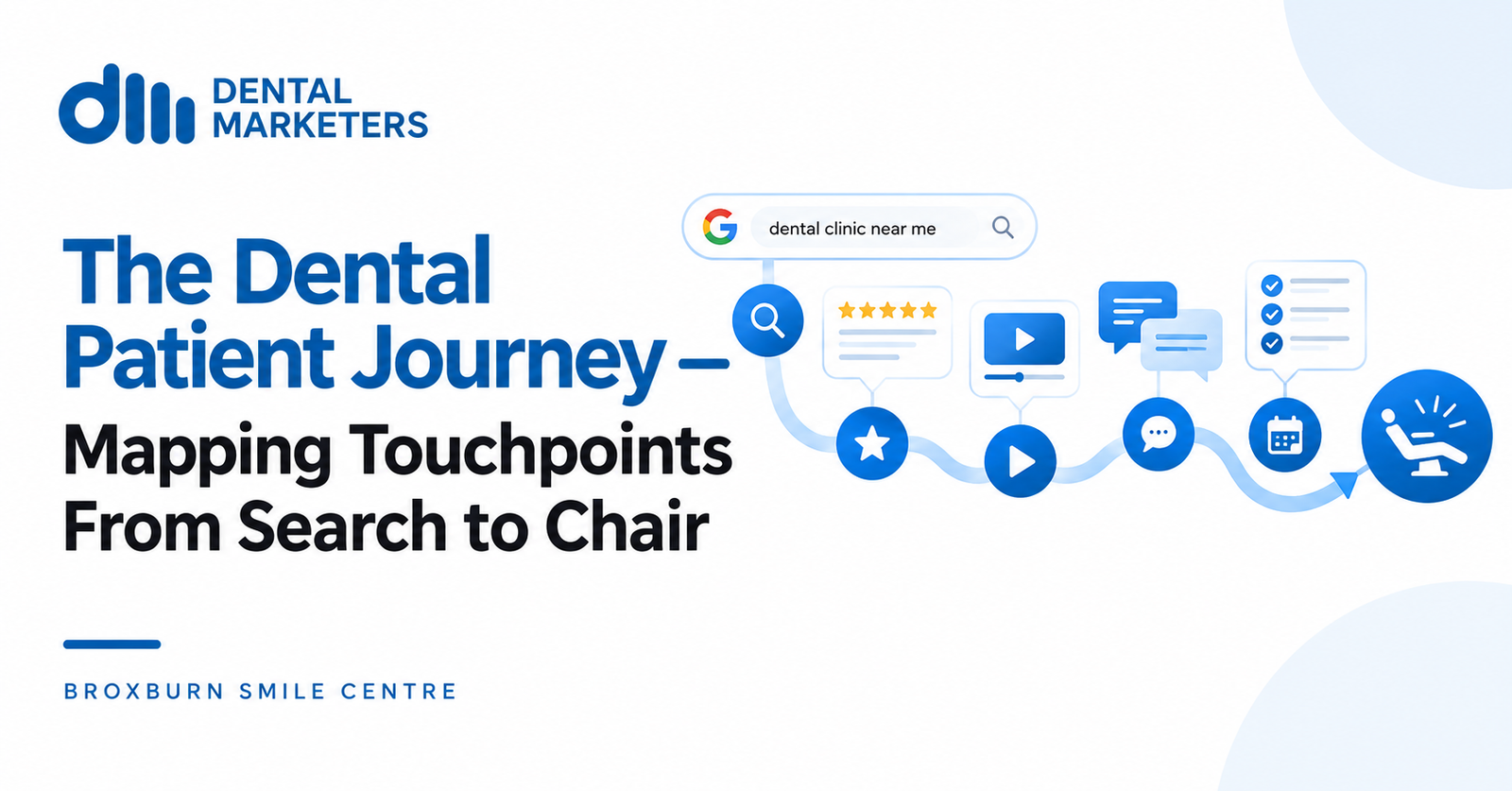
The dental patient journey is the full path a patient takes from their first search online through to ongoing aftercare, made up of touchpoints such as the website, phone call, arrival, appointment, and follow-up. Mapping these touchpoints across the pre-service, during-service, and post-service stages helps a practice identify exactly where patients are won or lost.
A patient’s journey starts long before they sit in the chair. It begins the moment they type a search into Google. This guide maps every touchpoint along that journey, from that first search through to aftercare. Understanding it helps your practice earn trust at every single step.
What Is the Dental Patient Journey?
The dental patient journey covers every interaction a patient has with your practice, from the very first search to years of ongoing care. This includes online research, phone calls, the physical visit itself, and everything that happens afterwards.
Marketers often call each of these interactions a “touchpoint.” A touchpoint is any moment where a patient forms an impression of your practice, whether that moment is intentional, such as a well-designed website, or unintentional, such as an online review left by someone else entirely.
Why Mapping Touchpoints Matters So Much
A practice can deliver excellent clinical care and still lose patients along the way. This happens when the surrounding journey, not the treatment itself, creates friction or doubt.
Here is why mapping this journey matters so much:
- Patients research online long before they ever call a practice
- A single weak touchpoint, such as a confusing website or an unanswered phone, can lose a patient entirely
- Trust builds gradually, across many small moments, not one single interaction
- Understanding the full journey helps a practice spot exactly where patients are being lost
- A smooth, consistent journey turns first-time patients into long-term, loyal ones
As a result, the patient journey is not simply a marketing concept. It is a genuine reflection of how a practice actually treats people, at every stage.
Picture two practices offering the same quality of treatment. One answers the phone warmly, keeps waiting times honest, and follows up after every appointment. The other delivers the same clinical outcome, but the phone rings out twice before anyone answers, and follow-up never happens at all. Patients rarely compare the dentistry itself. They compare how the whole journey felt.
Picture a patient who finds your practice through a search, but your website loads slowly and never mentions pricing clearly. They leave before ever picking up the phone. The treatment itself was never in question. The website simply lost them first.
Mapping the journey helps a practice see itself through a patient’s eyes, rather than through the practice’s own daily routine. It reveals exactly where confusion, delay, or doubt creeps in, long before those problems show up as a drop in new patient numbers.
The Three Stages of the Dental Patient Journey
Every dental patient journey moves through three broad stages. Understanding each one helps a practice know exactly where to focus attention.
Pre-service. This covers everything before a patient becomes a paying patient. Searching online, browsing a website, reading reviews, and making that first phone call all sit here.
During service. This covers the visit itself. Arriving at the practice, checking in, waiting, and the actual treatment all sit within this stage.
Post-service. This covers everything after treatment. Follow-up communication, aftercare advice, and the decision to return or recommend the practice all sit here.
Treating these three stages as one connected journey, rather than three separate jobs, is what actually improves the patient experience.
Key Touchpoints From Search to Chair
Follow this general path to understand where the most important touchpoints sit along a typical journey.
Step 1: The search itself. A patient searches for a service or a nearby practice, and your visibility here shapes everything that follows.
Step 2: The website visit. Clear information, easy navigation, and genuine reassurance either build trust or quietly lose it.
Step 3: The phone call or online enquiry. A warm, well-handled first contact often matters more than anything written on the website.
Step 4: Arrival and check-in. A calm, welcoming reception sets the tone for the entire appointment.
Step 5: The appointment itself. Clear communication from the dentist, not just clinical skill, shapes how the patient remembers the visit.
Step 6: Follow-up. A simple aftercare message or check-in call closes the loop and encourages the patient to return.
Each of these steps genuinely affects whether a patient stays, leaves, or recommends the practice to someone else. A single weak step rarely ends the journey outright, but several weak steps in a row usually do.
Who Owns Each Touchpoint?
Not every touchpoint sits fully within a practice’s control. Understanding who owns each one helps a practice know where to focus improvement efforts.
Practice-owned touchpoints. Your website, phone manner, and in-office experience. These sit fully within your control and are the easiest to improve directly.
Patient-owned touchpoints. A patient’s own research habits, questions, and expectations. These cannot be controlled directly, but can be genuinely understood and supported.
External touchpoints. Online reviews, word-of-mouth, and social mentions from other people. These sit outside direct control, but respond well to consistently good service over time.
Recognising this split stops a practice from either over-focusing on what it cannot control, or ignoring what it genuinely can improve. Most practices get the most value from starting with practice-owned touchpoints, since these are both fully controllable and often the easiest to fix quickly.
Key Benefits of Mapping Your Patient Journey
Understanding this journey properly brings real, practical rewards. For example:
- Fewer lost enquiries. Weak points get identified and fixed, rather than quietly costing new patients.
- Stronger first impressions. Every early touchpoint gets the attention it genuinely deserves.
- Better patient retention. A smooth journey naturally encourages patients to return and recommend the practice.
- Clearer team alignment. Staff understand exactly how their own role affects the wider journey.
- More effective marketing. Marketing spend works harder once it supports a genuinely smooth journey, rather than covering for a weak one.
Altogether, these benefits compound as a practice continues to grow and attract new patients.
Frequently Asked Questions
What is the dental patient journey?
It is the complete path a patient takes with a practice, from their first search online through to ongoing aftercare and future visits.
What is a touchpoint in dentistry?
A touchpoint is any moment where a patient forms an impression of a practice, from a website visit to a face-to-face conversation.
Why does the pre-service stage matter so much?
Most patients form early opinions online, long before they ever speak to the practice directly. A weak website or unclear information can lose them before contact even happens.
Can a practice control every touchpoint?
No. Some touchpoints, such as online reviews from other people, sit outside direct control, though they respond well to consistently good service.
How often should a practice review its patient journey?
Reviewing the journey once or twice a year helps catch new friction points as the practice, website, and patient expectations all change over time.
Does the patient journey end after treatment?
No. Follow-up, aftercare, and the decision to return or recommend the practice are all genuine parts of the journey too.
Ready to Map Your Own Patient Journey?
Every practice has a patient journey already, whether it has been deliberately mapped or not. Dental Marketers helps UK dental practices understand their journey properly, from that first search through to long-term loyalty. Left unmapped, small friction points tend to repeat quietly, costing new patients without anyone noticing why. Get in touch today, and let’s find out exactly where your patients are being won, and where they might be quietly slipping away.