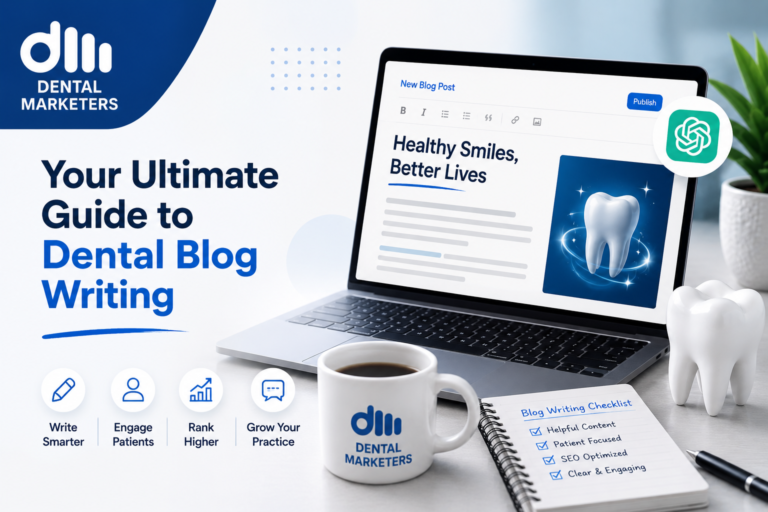
ChatGPT helps dental practices write blog content faster and more consistently. It speeds up research, drafting and editing, but a real dental team must always check every fact. Used the right way, it helps a practice publish helpful blogs that rank on Google and get picked up by AI search tools.
Blog writing takes time. Most dental teams are far too busy for it. Fortunately, ChatGPT can help you write faster without losing quality. This guide walks you through the exact steps, so your practice can publish better blogs with less effort.
What Is Dental Blog Writing with ChatGPT?
Dental blog writing with ChatGPT means using AI to help draft content for your practice website. First, you give ChatGPT a topic. Next, it writes a first draft. Then, your team edits that draft and adds real dental knowledge. As a result, you get a blog that saves time but still sounds like a real dentist wrote it.
This approach is not about letting AI do all the work. Instead, it means using AI as a starting point. You add the facts, the tone and the local details. This step keeps your content accurate, honest and easy to trust.
Why Dental Blog Writing Matters for Your Practice
A dental blog does far more than fill space on your website. Firstly, it helps new patients find your practice on Google. Secondly, it builds trust before a patient even books an appointment. Finally, it answers common questions, so your front desk gets fewer repeat phone calls.
Search engines such as Google favour websites that publish helpful, regular content. Likewise, AI search tools like ChatGPT and Perplexity now pull answers straight from trusted websites. Therefore, a strong blog can help your practice appear in both classic search results and AI-generated answers.
What’s more, patients often research before they choose a dentist. A clear, honest blog shows patients that your team is knowledgeable and approachable. Over time, this builds the kind of trust that turns a website visitor into a booked patient.
In addition, blogs help your website grow over time. Every new article gives Google another reason to crawl your site and understand what your practice offers. As a result, older blogs keep bringing in traffic long after you publish them, which makes the time you invest worthwhile.
How ChatGPT Helps You Write Better Dental Blogs
ChatGPT is useful at several stages of the writing process. For example, it can suggest blog topics based on what patients often search for online. It can also draft a full outline within seconds. Furthermore, it can turn dense dental terms into simple language that any patient can understand.
However, ChatGPT does not know your practice. It cannot describe your treatments, your team or your patients’ real experiences. Therefore, every draft still needs a human check. A dentist or a trained writer must review the content carefully before it goes live on your website.
In short, ChatGPT is a helpful assistant, not a replacement for your team’s expertise. When you combine AI speed with real dental knowledge, the results are far stronger than either one alone.
Example ChatGPT Prompts for Dental Blogs
Good prompts make a real difference. The more detail you give ChatGPT, the better your first draft will be. Here are three example prompts you can adapt for your own practice.
- “Write a friendly blog introduction about teeth whitening, aimed at nervous adult patients in the UK. Keep the tone warm and simple.”
- “Turn these dental facts about gum disease into five short bullet points that a patient could understand in one minute.”
- “Write three FAQ answers about dental check-ups, each in two sentences, using simple everyday words.”
Notice that each prompt names the topic, the audience and the tone. This level of detail helps ChatGPT produce a draft that needs far less editing afterwards.
Step-by-Step Guide to Writing Dental Blogs with ChatGPT
Below is a simple six-step process your team can follow every time you write a new blog. Each step builds on the one before it, so try not to skip ahead.
Step 1: Choose a Topic Patients Actually Search For
Start with real questions. Think about what patients ask at your front desk each week. Alternatively, use a keyword research tool to find common dental searches in your area. This step makes sure your blog answers a real need, not just a random idea.
Step 2: Give ChatGPT Clear Instructions
Be specific with your prompt. Tell ChatGPT the topic, the audience and the tone you want. For instance, ask for a friendly, simple tone written for nervous patients. Clear instructions lead to a much stronger first draft.
Step 3: Add Real Dental Facts and Experience
Once you have a draft, add real details. Include your practice’s own advice, your dentist’s experience and any local information that matters to your patients. This step is what turns a generic draft into trustworthy, useful content.
Step 4: Edit for Accuracy and Tone
Check every medical claim carefully. Dental advice must be correct, so always ask a dentist to review the draft before it is published. At the same time, make sure the tone still sounds like your practice, not a generic robot voice.
Step 5: Optimise for Google and AI Search
Add a clear heading structure throughout the blog. Use short paragraphs and simple words wherever possible. Also, include a short summary near the top, so both readers and AI tools can find the answer quickly.
Step 6: Publish and Track Results
Publish the blog on your website once it is fully checked. After that, track how it performs over time. Check which pages bring in new patients, and update older blogs whenever the information changes.
Key Benefits of Using ChatGPT for Dental Blogs
- Saves time on first drafts, so your team writes less from scratch
- Helps your practice publish blogs more often and more consistently
- Turns complex dental terms into simple, patient-friendly language
- Supports better rankings on Google over time
- Helps your content appear in AI search answers, such as AI Overviews
- Frees up your team to spend more time on patient care
Common Mistakes to Avoid
Many practices publish AI drafts without checking them first. This habit is risky because dental advice must always be accurate. Also, avoid generic content that could apply to any clinic in any city. Instead, add real local details and your own genuine voice.
Finally, don’t skip the FAQ section. Patients often search in question form, so a strong FAQ section helps your blog answer real questions directly. Skipping this step means missing an easy opportunity to be found.
Another common mistake is writing overly long paragraphs. Long blocks of text are hard to scan on a phone, and most patients read your blog on a mobile device. Therefore, keep paragraphs short, and break up long sections with clear subheadings wherever you can.
Frequently Asked Questions
Is it safe to use ChatGPT for dental blog content?
Yes, but only as a starting point. A dentist or a trained writer must always check the facts before the content is published.
Will Google penalise AI-written dental blogs?
No, Google does not penalise content simply for being written with AI. However, it does penalise low-quality or inaccurate content, so careful editing always matters.
How often should a dental practice publish blogs?
Most practices see good results with one to two blogs each month. Consistency matters more than volume, so a steady schedule works best.
Can ChatGPT write blogs that appear in AI Overviews?
Yes, as long as the content is clear, well-structured and factually correct. Short, direct answers near the top of the page help the most.
Does ChatGPT replace the need for a dental writer?
No, it does not. ChatGPT speeds up the drafting stage, but a human writer or dentist still needs to check facts, add real experience and keep the tone consistent with your brand.
Get Expert Help from Dental Marketers
Writing consistent, accurate dental blogs takes time and skill. If your team needs support, Dental Marketers can help. We combine smart AI tools with real dental marketing experience to build content that ranks well and builds genuine patient trust.
Get in touch with Dental Marketers today, and let’s grow your practice with content that actually works.
Also read: https://dentalmarketers.co.uk/dental-blog-importance/