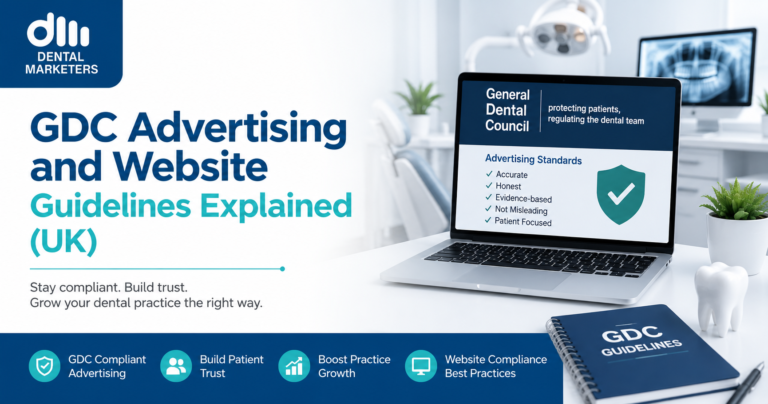
The General Dental Council (GDC) requires every UK dental professional to keep adverts and websites accurate, honest, and never misleading. Practices must show their GDC registration number, avoid unproven claims, and only use the term “specialist” if they sit on the GDC specialist list.
Running a dental practice takes more than skill in the chair. You also need to market your services the right way. The GDC sets clear rules for this. These rules protect patients from false claims. In this guide, we explain exactly what the GDC expects from your adverts and your website. As a result, you can stay compliant and still promote your practice with confidence.
What Are the GDC Advertising Guidelines?
The GDC advertising guidelines are official rules from the General Dental Council. They control how dentists and dental practices promote their services. In short, every advert, leaflet, and web page must be accurate, decent, and truthful. Furthermore, nothing should mislead a patient or raise false hope about results. These rules apply to every dental professional, not just dentists. So, hygienists, therapists, and other team members must follow them too.
Why Do These Guidelines Matter?
Patients often feel unsure about dental treatment. Many do not know how to judge a dentist’s skills or results. Therefore, they rely heavily on what a practice says in its adverts and on its website. If that information misleads them, they may choose the wrong treatment or the wrong practice. In the worst cases, this can put patient safety at risk. Because of this, the GDC treats advertising rules as seriously as clinical standards.
Moreover, clear guidelines help the whole profession, not just one practice. When every practice follows the same standard, patients can compare services fairly. As a result, trust grows across the industry over time. This benefits patients today, and it protects the reputation of dentistry for years to come.
The GDC Advertising and Website Guidelines in Detail
The GDC guidance covers several areas. Therefore, it helps to break each one down clearly.
Accuracy and honesty come first. Standard 1.3.3 states that all advertising must be accurate and not misleading. Consequently, every claim you make needs solid evidence behind it. You must also avoid vague or ambiguous wording that could confuse a patient. For example, avoid phrases that promise a certain result without proof.
Your registration number matters. Wherever your name appears in an advert, you must include your GDC registration number. This gives patients an easy way to check your status on the GDC register. In addition, it builds trust straight away, since patients can verify who is treating them.
NHS, private, or mixed status must be clear. Patients need to know what type of practice they are choosing. So, your website and adverts must state this plainly. This helps patients understand costs before they book an appointment.
Extra training needs proper disclosure. If you offer a treatment outside your core training, you must gain proper extra training first. Then, you must explain this clearly to patients. You should never imply skill you do not have simply because of your base qualification.
Product endorsements need real evidence. You can recommend a product if it suits your patient’s needs. However, you must back this up with facts that other people can check. You should also avoid suggesting the whole profession shares your view of that product.
Social media counts as advertising too. Platforms such as Instagram, TikTok, and LinkedIn fall under the same rules. Therefore, any offer you post must state that treatment depends on a proper assessment first. You must also carry out a full consultation before any work begins, even if a patient books through a social media advert.
Your website needs specific information. The GDC requires your site to show:
- your practice name and full geographic address
- your contact details, including email and phone number
- the GDC’s contact details or a link to the GDC website
- your complaints procedure, so patients know where to turn if something goes wrong
- the date your site was last updated
Specialist titles are protected. You can only use the word “specialist” if you sit on the GDC specialist list. If not, you may say you have a “special interest in” a treatment instead. This small change in wording keeps you fully compliant while still highlighting your skills.
Qualifications must stay clear, not abbreviated. Listing memberships or fellowships in shortened form can mislead patients into thinking you hold extra qualifications. As a result, the GDC asks you to write these out in full or leave them off entirely.
Step-by-Step Guide to Making Your Website Compliant
Follow these simple steps to bring your practice in line with GDC rules.
Step 1: Audit your current content. First, read through every page on your site. Look for claims that sound exaggerated or unproven, such as “the best” or “leading”. Then, make a list of anything that needs a rewrite. This gives you a clear starting point.
Step 2: Add your registration details. Next, place your GDC number on your team page. Also, add it near your name wherever it appears, including on social media bios and adverts.
Step 3: Review your titles and claims. After that, check every title you use across your site. Remove any term that implies specialist status unless you truly hold that status. Replace it with approved wording, such as “experienced in” or “special interest in” a treatment.
Step 4: Add the required legal pages. Then, make sure your site includes a complaints procedure, a privacy policy, and contact details for the GDC. This step covers the transparency your patients expect and rightly deserve.
Step 5: Keep your site current. Finally, update your site regularly. Show the date of the last update in your footer. This proves your information stays fresh, accurate, and trustworthy over time. Set a simple reminder every few months to check your content again. This way, nothing slips through the cracks as your team or services change.
Key Benefits of Following GDC Guidelines
Staying compliant brings real value to your practice, not just peace of mind.
- Stronger patient trust — clear, honest information helps patients feel confident in your care from the very first visit.
- Lower legal risk — compliant adverts reduce the chance of a fitness to practise investigation or a formal complaint.
- Better reputation — practices that follow the rules stand out as professional, careful, and reliable.
- Smoother marketing — clear guidelines actually make content easier to write, since you know exactly what to include and what to avoid.
- Long-term protection — good habits now save you time, money, and stress later on.
- Fair competition — when every practice follows the same rules, patients can compare services honestly.
Frequently Asked Questions
What is the GDC’s main rule on advertising?
All advertising must be accurate, decent, honest, and not misleading. This sits at the heart of every other GDC rule.
Can I call myself a specialist on my website?
Only if you appear on the GDC specialist list. Otherwise, use wording such as “special interest in” instead.
Do I need to show my GDC number online?
Yes. Your GDC registration number must appear wherever your name is shown online, including on social media.
Does the GDC regulate social media adverts too?
Yes. Any post on platforms like Instagram or TikTok must follow the same advertising rules as your website.
What happens if my website breaks GDC rules?
You could face a fitness to practise investigation. In serious cases, this can also count as a criminal offence.
How often should I update my website?
You should update it as soon as anything changes, such as new staff or new services. Always show the date of the last update.
Can I recommend a specific dental product on my site?
Yes, but only if it is the best option for your patient’s needs. You must also back up any claims with real evidence.
Do these rules apply to dental hygienists and therapists too?
Yes. Every dental professional on the GDC register must follow the same advertising and website rules, not just dentists.
Where can I find the official GDC advertising guidance?
The GDC publishes its full guidance on advertising on its official website. It sits alongside the wider Standards for the Dental Team.
Need Help With Dental Advertising Compliance?
Getting your website right can feel like a lot to manage alongside running your practice. That’s exactly where Dental Marketers comes in. Our team understands GDC rules inside and out, and we build websites and adverts that stay fully compliant while still bringing in new patients. Get in touch with Dental Marketers today, and let us handle the compliance while you focus on your patients.