
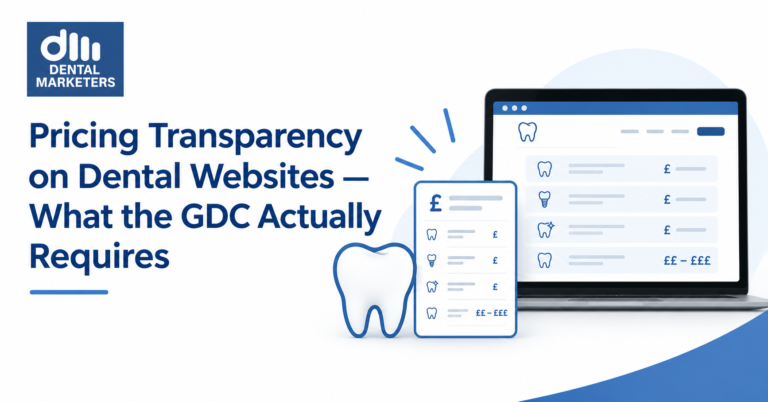
The General Dental Council (GDC) requires every UK dental professional to give patients clear information about costs under Standard 2.4. In practice, this means a simple price list must be clearly displayed in the practice, and the GDC also expects clear pricing information on the practice website. For treatments that vary in cost, a ‘from–to’ price range is allowed.
Many UK dental websites hide their fees. Yet the GDC expects the opposite. Patients have a right to clear costs before they book. So, what does the regulator actually require? This guide breaks down the rules in plain English. It also gives you a simple checklist to make your website compliant today.
What Is Pricing Transparency on a Dental Website?
Pricing transparency means showing your treatment costs openly on your website. Patients should find your fees without calling or emailing first. In short, it means a clear price list, honest ‘from’ prices, and no hidden charges. For UK practices, this is not just good manners. It is part of your professional duty under GDC standards.
What the GDC Actually Requires
The rules come from the GDC’s Standards for the Dental Team, which took effect in September 2013. Every registrant must follow them. If a complaint is made, your conduct is judged against these standards.
Here is what they say about pricing.
Standard 2.4 states: “You must give patients clear information about costs.” This is the core rule. It applies to NHS, private and mixed practices alike.
Standard 2.4.1 goes further. It says a simple price list must be clearly displayed in your reception or waiting area. According to the GDC, this list must include basic items as a minimum:
- A consultation
- A single-surface filling
- An extraction
- Radiographs (X-rays)
- Treatment provided by the hygienist
For treatments that vary in cost, such as implants or Invisalign, the GDC allows a ‘from–to’ price range. So you do not need one fixed price for every treatment. But you do need an honest range.
What about your website? This is where many practices get confused. The GDC’s own dental costs guidance states that dental professionals must also give clear information on their prices in their practice literature and on their website. In other words, a price list behind the reception desk is not enough. Your website must carry clear pricing too.
Standard 1.3.3 adds another layer. It says all advertising and promotional material must be accurate and not misleading. Your website counts as advertising. As a result, vague pricing, hidden fees or ‘bait’ prices could all breach this standard.
On top of that, the GDC’s guidance on advertising sets out what dental websites must display. This includes the name and GDC number of each clinician, their qualifications and country of qualification, your complaints procedure, a ‘last updated’ date, and whether the practice is NHS, mixed or private. Pricing sits within this same duty of honest, clear communication.
Finally, the GDC expects patients to receive a written treatment plan with a cost estimate before treatment starts. Clear website pricing makes that conversation far easier. Because of this, transparency protects you as much as it protects the patient.
The Rules Do Not Stop at the GDC
The GDC is not the only body watching your pricing. Three others matter too.
The ASA and the CAP Code. The Advertising Standards Authority covers your website, ads and social posts. Under its rules, a ‘from’ price must include all non-optional charges. Also, if the final cost depends on a consultation, you should say so clearly. A low headline price that nobody ever pays is a problem waiting to happen.
The CQC. The Care Quality Commission inspects practices in England. Inspectors expect patients to receive clear information about fees as part of good, responsive care. Clear website pricing supports this.
The CMA. The Competition and Markets Authority has launched a review of private dentistry. It found that many patients see the market as complex and confusing. They struggle to understand costs or compare providers. Because of this, scrutiny on pricing is only going to grow. Practices that publish clear fees now will be ahead of the curve.
How to Make Your Dental Website Price-Compliant
Follow these seven steps. Most practices can complete them in a week.
- Create a dedicated fees page. Give it a clear name, such as ‘Fees’ or ‘Price List’. Then link to it from your main menu. Patients should find it in one click.
- List the GDC basics first. Include a consultation, a single-surface filling, an extraction, X-rays and hygienist visits. After that, add your other treatments.
- Use honest ‘from–to’ ranges. For variable treatments, show a realistic range. Make sure the ‘from’ price includes all non-optional charges. If the final cost depends on a consultation, say so.
- Show your NHS status and charges. State clearly whether you offer NHS, private or mixed care. If you treat NHS patients, display the current NHS band charges for your nation.
- Publish prices as text, not a PDF. A page of real text is easier for patients to read on mobile. It also helps Google and AI tools find your fees. A PDF can sit alongside it as a download.
- Review your prices every quarter. Out-of-date prices can mislead patients. So set a reminder, update the page, and refresh your ‘last updated’ date each time.
- Check the rest of your website too. Add each clinician’s GDC number and qualifications. Include your complaints procedure. Remove any ‘specialist’ claims unless the clinician is on a GDC specialist list.
Common Mistakes to Avoid
We review dental websites every week. The same errors come up again and again. For example:
- No fees page at all. The biggest risk. Patients assume the practice is expensive and move on.
- A ‘from’ price that excludes the consultation fee. This can mislead patients and breach ASA rules.
- Prices buried in a PDF from 2022. Old prices are worse than no prices. They set the wrong expectation at the first visit.
- No NHS status shown. Patients cannot tell if a check-up costs an NHS band charge or a private fee. As a result, many never call to ask.
Each of these is quick to fix. Yet each one quietly costs the practice trust and new patients.
Why Pricing Transparency Helps Your Practice
Compliance is the floor, not the ceiling. Clear pricing also brings real commercial gains:
- More enquiries. Patients trust practices that publish fees. Hidden prices make people assume the worst.
- Better-qualified patients. People who see your fees before booking are ready to pay them. So you waste less chair time.
- Fewer complaints. Most fee disputes start with surprise. Clear costs upfront remove that surprise.
- Stronger local SEO. Google rewards pages that answer ‘how much does X cost’ searches. A clear fees page can rank for dozens of these.
- AI visibility. Tools like ChatGPT and Google AI Overviews pull answers from clear, structured pricing pages. Vague pages get skipped.
- Easier treatment conversations. Also, your team spends less time defending fees and more time discussing care.
Frequently Asked Questions
Do I legally have to show prices on my dental website?
The GDC states that dental professionals must give clear information on their prices in their practice literature and on their website. So yes, clear website pricing is expected, not optional.
Can I use ‘from’ prices on my website?
Yes. The GDC allows ‘from–to’ ranges for treatments that vary in cost. However, the ASA expects a ‘from’ price to include all non-optional charges. It must be a price real patients actually pay.
What must a dental price list include as a minimum?
The GDC lists five basics: a consultation, a single-surface filling, an extraction, radiographs, and hygienist treatment. Most practices add their full treatment menu on top.
Do NHS practices need to display prices too?
Yes. NHS practices should display the current NHS band charges. Mixed practices should show NHS charges alongside private fees, so patients can make an informed choice.
What happens if my website is not compliant?
Unclear pricing can lead to patient complaints. In serious cases, the GDC can take action against a registrant through fitness to practise proceedings. It also damages patient trust, which costs you enquiries.
Is a PDF price list on my website enough?
It is better than nothing, but a proper web page works best. Text on a page is easier to read on mobile, easier to update, and far easier for search engines to index.
Get a Compliant, Patient-Friendly Dental Website
Not sure if your fees page meets GDC expectations? You are not alone. Most dental websites we review fail at least one pricing rule. The good news is that fixing it is simple with the right support. Dental Marketers builds compliant, high-converting websites for UK dental practices. We handle your fees page, your GDC website checklist and your dental marketing services for UK clinics — all in one place. Book a free website review today and see exactly where your practice stands.