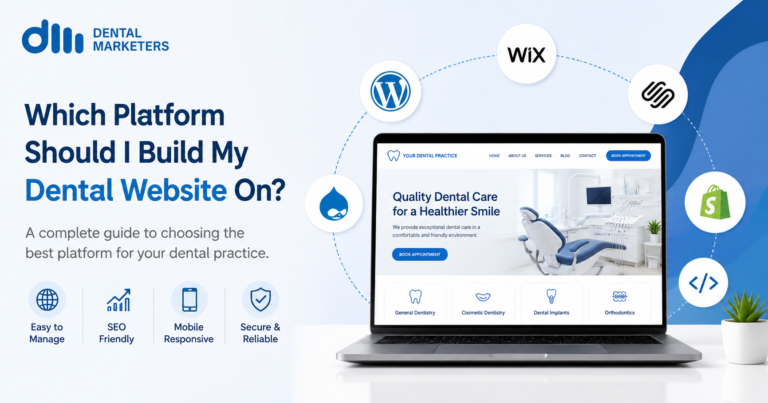
WordPress is the best dental website platform for most UK practices. It gives you full ownership, strong SEO tools, and room to grow. Wix and Squarespace are easier at first, but they lock your site into their own system and limit your growth over time.
Choosing a website platform is one of the first big decisions for any dental practice. The right platform helps patients find you online. It also lets you edit your site with ease. In this guide, we compare the top platforms clearly. We then show you exactly how to pick the best one for your practice.
What Is a Dental Website Platform?
A dental website platform is the software behind your website. It lets you build, edit, and manage your pages. Popular options include WordPress, Wix, and Squarespace. Each one works in a different way, and each one has its own strengths and limits.
In simple terms, the platform is the engine. Your design sits on top of it. So, the platform you choose affects your speed, your growth, and how well your site performs on Google.
Wix, Squarespace, and WordPress Compared
So, how do these three platforms actually differ? Let’s break it down clearly, so you know exactly what you are choosing between.
Wix and Squarespace
Wix and Squarespace are simple to use. That is why many beginners choose them first. However, both platforms lock you in. You cannot easily move your site to another provider without starting again from scratch.
Also, you never truly own your website with these tools. Instead, you rent space inside their system, and you pay a monthly fee forever. If you stop paying, your site disappears completely.
Furthermore, these platforms have real limits. As your practice grows, you may need more features, more pages, or more control. Sadly, Wix and Squarespace often cannot keep up with a growing practice. As a result, many dentists switch away later on, and this switch costs extra time and money.
In addition, these builders use their own unique code. So, they do not always follow standard web practices. This can make some tasks harder than they should be, even simple ones like adding a new treatment page.
WordPress
WordPress is open-source software. This means it is free to use, and any developer can build on it. Today, WordPress powers over 40% of all websites online. Therefore, it has huge community support, strong security updates, and thousands of tools built for it.
Most importantly, WordPress gives you full ownership. You are not locked into one single company. Additionally, it works brilliantly with SEO tools. This helps your practice show up higher on Google, which means more new patients find you.
Because of this, WordPress is the top choice for any dental website that plans to grow. It also works well for practices that want strong content, clear treatment pages, and fast loading speeds.
Not All WordPress Sites Are Equal
Be careful, though. Some designers use ready-made WordPress themes. These themes often look generic, and many other websites use the exact same layout. Over time, these themes can become outdated, and they may cause problems without proper ongoing support.
So, always ask if your website will be custom-built, or built from a template. A bespoke WordPress site, built just for your practice, will always perform better and last much longer.
What About a Designer’s Own Custom System?
Some website designers build sites on their own private system, instead of WordPress. This might sound impressive at first. However, it is risky. If you ever leave that designer, no one else can work on your site. You may need to rebuild your whole website from zero. So, always ask what system your site runs on before you agree to anything.
How to Choose the Right Platform: Step by Step
Step 1: Think about long-term growth. Ask yourself where your practice will be in five years. If you plan to grow, choose a flexible platform like WordPress.
Step 2: Check who owns the website. Always ask if you will fully own your site and its content. If not, walk away from the deal.
Step 3: Ask about SEO support. A good platform should support strong, modern SEO. This includes fast loading speed, clean code, and mobile-friendly pages.
Step 4: Confirm it is custom, not templated. Avoid generic themes wherever possible. Instead, choose a bespoke design built just for your practice.
Step 5: Ask about ongoing support. Your website will always need updates. So, check exactly what support is included after your site goes live.
Step 6: Compare the true long-term cost. A cheap platform now can cost far more later, once you factor in migration, redesign, and lost SEO rankings.
Key Benefits of Choosing WordPress
- You fully own your website, so you can move it whenever you like.
- It supports strong SEO, which helps more patients find you on Google.
- It has a huge global community, so expert help is always available.
- It is flexible, and it grows easily as your practice grows.
- It works with almost any developer, not just one single provider.
- It loads quickly, which keeps both patients and Google happy.
- It supports strong security, thanks to constant updates and monitoring.
Cost, Security, and Long-Term Value
Wix and Squarespace often look cheaper at the start. However, you pay every single month, forever, with no way to stop. WordPress can cost more upfront, since it is often custom-built. Yet you own the finished result completely, and you are not tied to endless monthly fees.
Security matters too. WordPress receives constant updates from a huge global community. So, when handled properly, it stays safe and reliable for years. This matters greatly for a dental website, since patients trust you with their personal details.
Is Your Platform Ready for AI Search?
Search is changing fast. More patients now find practices through AI tools, not only through Google’s normal results. So, your platform needs to support clear, well-structured content that these AI tools can read and trust.
WordPress makes this easy. It supports clean code, clear headings, and simple FAQ sections, just like this one. Wix and Squarespace can struggle here, since their code is often harder for search engines and AI tools to read properly.
In short, a flexible platform today means better visibility tomorrow. This is true whether patients search on Google, ask ChatGPT, or use any other AI tool to find a dentist near them.
Common Mistakes to Avoid
- Picking a platform based on price alone, without thinking long term.
- Signing up with a builder that will not let you export your content.
- Choosing a generic theme instead of a bespoke design.
- Forgetting to ask who actually owns the finished website.
- Ignoring SEO and AI search readiness until it is too late.
Frequently Asked Questions
Is WordPress good for a dental website?
Yes. WordPress offers strong SEO, full ownership, and long-term flexibility for dental practices of any size.
Should I use Wix or Squarespace for my dental practice?
Both are fine for a very quick start. However, they lock you into their system, and you never fully own your website.
What is the best platform for dentists?
WordPress is the best platform for dentists who want growth, ownership, and strong long-term SEO results.
Can I move my website later if I start with Wix?
No. Wix does not allow you to export your site fully. You would need to rebuild it from scratch elsewhere.
Do I need coding skills to use WordPress?
No. Once your site is built, you can edit text, images, and pages without any coding knowledge at all.
Is a WordPress theme the same as a bespoke WordPress website?
No. A theme is a ready-made template. A bespoke site is designed and built specifically for your practice.
Need Help Choosing the Right Platform?
Picking a platform is only the first step. At Dental Marketers, we build bespoke WordPress websites for dental practices right across the UK. We make sure you fully own your site, your site ranks well on Google, and your site is ready to grow for years to come. Get in touch with Dental Marketers today, and let’s build a website that works as hard as you do.
Related Reading: Crafting Smiles Online – The Art of Dental Web Design Services
Written by: Dental Marketers Team, Dental Marketing Experts in the UK
Last updated: July 2026