
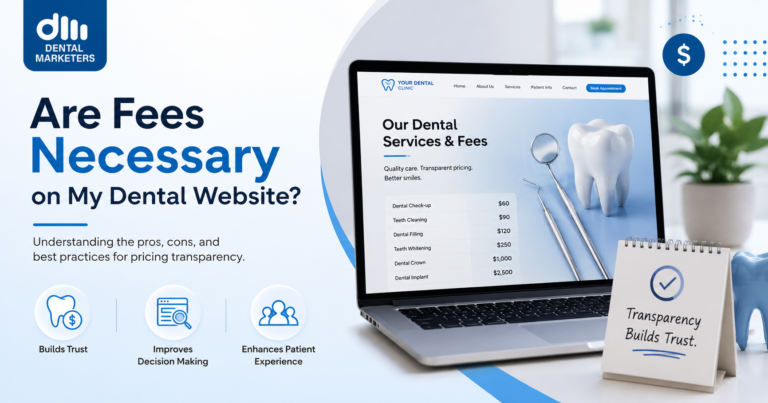
Many dentists ask this question every single day. Should you show your fees on your website, or should you keep them hidden? This is a fair question, and it deserves a clear answer. In this article, we will look at the real benefits of showing fees, the risks of hiding them, and the best way to display prices online.
By the end, you will know exactly what to do for your own practice. So, let’s get started.
Yes, fees are necessary on your dental website. Patients want clear pricing before they book. Showing fees builds trust. It also saves your front desk team time, because fewer patients call just to ask about cost. In short, clear pricing helps patients and helps your practice too.
Why Patients Want to See Fees First
Think about how you shop online. Before you buy anything, you check the price. Dental care works the same way. Patients search for treatments and costs together. For example, they often type “teeth whitening cost” or “dental implant price” into Google.
If your website has no fees, patients cannot compare you with other practices. As a result, they may leave your site and visit a competitor instead. Furthermore, hidden fees can create doubt. Patients may wonder if the price is high, or if there is a hidden catch. Therefore, clear pricing removes doubt right from the start.
Additionally, most patients research treatment online before they call anyone. A 2025 Google survey found that most health patients check three or more websites before choosing a provider. This means your website often makes the first impression. Consequently, price is one of the first things a patient looks for.
The Risk of Hiding Your Prices
Some practices worry that showing fees will scare patients away. However, the opposite is usually true. Hidden fees often cause more harm than good. Here is why.
First, patients feel unsure when they cannot find a price. Uncertainty leads to hesitation, and hesitation leads to lost bookings. Second, your front desk team spends more time answering the same questions again and again. This wastes staff hours that could be used for patient care instead.
Third, and most importantly, transparency builds trust. Trust is the foundation of every good patient relationship. When patients feel informed, they feel respected. In turn, this makes them more likely to book with you rather than a competitor who hides their prices.
How Clear Pricing Helps Your SEO
Search engines like Google want to give users clear, useful answers. In fact, Google now often shows an AI Overview at the top of search results. This box pulls information straight from helpful, well-structured web pages. If your website answers pricing questions directly, search engines are more likely to feature it.
Moreover, pages with clear pricing tend to keep visitors on the page longer. This is because visitors get their answer without needing to click away. Google notices this signal, and it can help your page rank higher over time.
In addition, fee pages naturally include valuable keywords, such as treatment names and locations. This makes it easier for search engines to match your page with local searches. As a result, adding fees is not just good for patients. It is good for your visibility online too.
What Type of Pricing Should You Show?
Not every practice needs to list an exact price for every single treatment. Instead, you have a few good options to choose from.
Fixed prices work well for simple, common treatments. Examples include a check-up, a clean, or a whitening session. Because these treatments do not vary much, a fixed price is easy and honest.
Starting prices work well for treatments that depend on the patient. Examples include implants, braces, or complex root canal work. In this case, you can write “From £X,” followed by a short note that the final price depends on the assessment.
Price ranges work well when a treatment has a few common variations. For example, you might list “£X to £Y,” depending on materials or complexity.
Whichever option you choose, always explain why prices may change. This small step avoids confusion and builds even more trust.
Where to Place Fees on Your Website
Placement matters just as much as the price itself. Here are the best places to add pricing information.
Firstly, create a dedicated fees or pricing page. Make sure it is easy to find in your main menu. Secondly, add short price notes directly on each treatment page. This helps patients get an answer without needing to search further. Thirdly, keep your pricing page simple and easy to scan. Use short paragraphs, clear headings, and simple tables where possible.
Finally, update your fees regularly. Old or wrong prices can damage trust faster than no price at all. Therefore, review your pricing page at least twice a year.
Common Mistakes to Avoid
Even well-meaning practices make small mistakes with fees. Here are some to watch for.
One mistake is burying prices deep inside a PDF file. Patients often skip PDFs, especially on mobile phones. Another mistake is using confusing language, such as unclear treatment names. Always use simple, everyday words that patients understand.
A further mistake is failing to mention consultation fees. If a first visit costs money, say so clearly. Otherwise, patients may feel misled when they arrive. Lastly, avoid making patients call just to learn a basic price. This creates friction, and friction often leads to lost bookings.
How Fees Affect Patient Trust
Trust does not happen by accident. It grows over time, and small details help build it. Pricing is one of those details. When patients see a clear fee, they feel like your practice has nothing to hide. This feeling matters more than most dentists realise.
Consider a simple example. Two practices offer the same treatment. One shows a clear price. The other says “call for pricing.” Most patients will choose the practice with the clear price first. Why? Because it feels open and honest. It also saves them time.
Furthermore, clear pricing shows respect for the patient’s time and money. Nobody enjoys guessing how much a visit might cost. By removing this guesswork, you show patients that you value their comfort. As a result, they feel more confident booking with you.
Trust also grows through consistency. If your website, your reception desk, and your treatment room all give the same price, patients notice. This consistency reduces confusion and prevents awkward conversations later. In turn, this leads to smoother visits and happier patients overall.
Fees and the Patient Journey
Every patient goes through a journey before they book an appointment. First, they notice a need, such as tooth pain or a cosmetic concern. Next, they search online for solutions. After that, they compare a few practices. Finally, they choose one and book.
Price plays a role at almost every stage of this journey. During research, patients use price to narrow down their choices. During comparison, price often becomes the deciding factor between two similar practices. Even during booking, patients like to double-check the cost one final time.
Because of this, your website should support the patient at each stage. Clear fees on your homepage help during research. Clear fees on treatment pages help during comparison. And a simple, visible pricing page helps during the final booking stage. When all three work together, patients move through the journey with far less friction.
A Simple Checklist for Your Pricing Page
Before you publish or update your pricing page, run through this simple checklist:
- Does every common treatment show a price, a starting price, or a price range?
- Is the language simple, with no confusing dental jargon?
- Does the page explain why prices may vary for certain treatments?
- Is the consultation fee, if any, clearly stated?
- Can a first-time visitor find the page within two clicks?
- Is the page mobile-friendly, with no reliance on PDF downloads?
- Has someone reviewed the prices in the last six months?
If you can answer yes to each point, your pricing page is in strong shape. If not, these are simple, quick wins you can fix today.
Frequently Asked Questions
Do I have to show an exact price for every treatment? No, you do not. You can use starting prices or price ranges for treatments that vary between patients. The key is to give patients a clear starting point, rather than no information at all.
Will showing my fees make me look cheap? No, it will not. Clear pricing looks professional and confident. Patients often see hidden fees as a bigger warning sign than a visible price.
What if my prices change often? That is fine. Just review your website regularly, and update the numbers as soon as they change. A quick review every few months keeps your page accurate and trustworthy.
Should I compare my prices to competitors on my website? No, this is not necessary. Focus on your own prices and your own value. Patients can compare practices on their own if they choose to.
Final Thoughts
So, are fees necessary on your dental website? The answer is yes. Clear pricing builds trust, saves staff time, and helps your website perform better in search results. Patients want simple, honest answers, and your website is the best place to give them.
In summary, add clear prices, explain why costs may vary, and place this information where patients can find it easily. This small change can make a big difference to your bookings and your reputation.
| Need Help Presenting Your Fees the Right Way? Getting your pricing page right takes more than just adding numbers to a page. It takes careful wording, smart layout, and a strategy built around search visibility. At Dental Marketers, we help dental practices build clear, trustworthy websites that turn visitors into booked patients. Our team understands both patient psychology and search engine behaviour, so your fees page works hard for you in every way. Get in touch with Dental Marketers today, and let us help your practice show up, stand out, and win more bookings. |