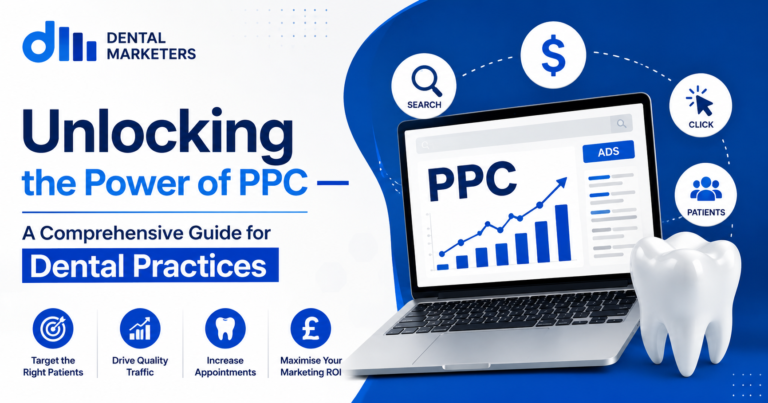
Running a dental practice in the UK is competitive. New patients are searching online every single day. And the practices that show up first are the ones winning those bookings. That is exactly where PPC for dental practices comes in.
As part of effective dental marketing services in the UK, PPC stands for pay-per-click advertising. It lets you place your practice at the top of search results — instantly. You only pay when someone clicks. So your budget goes directly toward people who are already looking for a dentist.
This guide covers everything you need to know. From what PPC is, to how it works across Google and Meta, to what it costs and how to track results. Whether you are brand new to paid advertising or looking to sharpen your strategy, this is your starting point.
What Is PPC and Why Does It Matter for Dentists?
PPC is a form of digital advertising where you bid to show your ads in front of the right people. When someone clicks your ad, you pay a small fee. Simple as that.
For dentists, this is powerful. Think about it. Someone in your town types “emergency dentist near me” into Google. With PPC, your practice can appear right at the top — above all the organic results. Without PPC, you might not appear at all.
Unlike SEO, which takes months to build, PPC produces results straight away. You launch a campaign today, and you can be getting clicks by tomorrow. That speed matters, especially when you are trying to fill appointment slots fast.
Furthermore, PPC is fully measurable. You can see exactly how much you spent, how many people clicked, and how many booked. There is no guesswork involved.
The Key PPC Platforms for Dental Practices
Not all PPC platforms work the same way. Each one has different strengths. Here is a breakdown of the main options for dental practices.
Google Ads
Google Ads is the most important platform for dental PPC. It captures patients at the exact moment they are searching. These are high-intent users — people ready to book.
You bid on keywords like “dental implants London” or “Invisalign near me.” When someone searches those terms, your ad appears. You only pay when they click through to your website.
Google Ads also includes the Google Display Network. This lets you show visual banner ads across thousands of websites. It is great for brand awareness and remarketing — which we will come to shortly.
Meta Ads (Facebook and Instagram)
Meta Ads work differently. Instead of targeting people who are actively searching, you reach people based on who they are — their age, location, interests, and behaviours.
For dental practices, this is brilliant for treatments like Invisalign, composite bonding, and smile makeovers. These are considered purchases. Patients do not always search Google first. They see a before-and-after photo on Instagram and then want to know more.
Additionally, Meta Ads are highly visual. You can use photos and videos of real results. That builds trust before a patient even lands on your website.
Microsoft Ads (Bing)
Bing has a smaller audience than Google. However, it tends to attract an older, more affluent demographic. CPCs are also lower. For private dental practices targeting patients for implants or full-mouth restorations, Bing is worth considering alongside Google.
Treatment-Specific PPC Campaigns — Why One Size Does Not Fit All
One of the biggest mistakes dental practices make with PPC is running a single generic campaign. It rarely works.
Instead, build separate campaigns for each high-value treatment. Here is why that matters.
Someone searching for dental implants has completely different needs to someone looking for a check-up. They need different messaging, different landing pages, and different calls to action. A patient researching implants wants to know about the procedure, the cost, and the long-term benefits. A patient looking for an emergency appointment wants a phone number and a same-day slot.
Therefore, structure your campaigns by treatment. Common high-value campaign types include:
- Dental implants
- Invisalign and clear aligners
- Composite bonding
- Teeth whitening
- Veneers and smile makeovers
- Emergency dentistry
- NHS vs private patient acquisition
This approach improves your Quality Score on Google Ads. That means lower cost-per-click and better ad positions. It is a win on every level.
Keywords, Match Types, and Negative Keywords
Keywords are the engine of any Google Ads campaign. Get them right and you attract patients ready to book. Get them wrong and you waste money on irrelevant clicks.
Keyword Match Types
Google Ads gives you control over how closely a search must match your keyword before your ad appears. The three main types are:
Broad Match — Your ad shows for searches related to your keyword, including synonyms and variations. Wide reach but less control.
Phrase Match — Your ad shows when the search includes your keyword as a phrase. More controlled and targeted.
Exact Match — Your ad only shows for the exact keyword. Highly targeted and efficient.
For dental practices, a mix of phrase and exact match typically performs best. This gives you strong intent targeting without limiting reach too much.
Negative Keywords
Negative keywords stop your ads from showing for irrelevant searches. This is one of the most important — yet most overlooked — parts of dental PPC.
For example, if you run a private practice, you do not want your ads appearing for searches like “NHS dentist near me” or “free dental care.” Adding these as negative keywords saves your budget for the patients you actually want.
Similarly, if you run implant campaigns, add negatives like “dental implant DIY” or “cheap implants abroad.” These searchers are not your patients.
Quality Score, Ad Rank, and What They Mean for Your Budget
Google does not just award the top ad position to the highest bidder. It uses a metric called Ad Rank, which combines your bid with your Quality Score.
Quality Score is Google’s rating of your keyword, ad copy, and landing page relevance. It is scored from 1 to 10. A higher Quality Score means you pay less per click and appear higher in results.
In practice, this means a well-optimised dental PPC campaign can outrank a competitor spending more money. You just need to ensure your ads are relevant, your landing pages match the search intent, and your click-through rate is strong.
So always align your ad copy tightly with your landing page. If your ad says “Invisalign from £2,499,” your landing page should be specifically about Invisalign — not your general treatments page.
Budgeting for Dental PPC — What Should You Spend?
Budget is one of the first questions practices ask. And it is a fair question.
Dental keywords are competitive. Cost-per-click for terms like “dental implants” can range from £3 to £12 or more depending on your location and competition. London and other major cities tend to have higher CPCs than rural areas.
A realistic starting budget for a single-treatment campaign is £500 to £1,000 per month. To run multiple campaigns across implants, Invisalign, and general dentistry, most practices invest £1,500 to £3,000 per month.
The key metric is cost per acquisition (CPA). If you spend £1,000 and bring in three implant patients worth £3,000 each, your ROI speaks for itself. Always track what each lead costs you — and what it is worth.
Ad Extensions — Getting More From Every Ad
Ad extensions are additional pieces of information that appear alongside your Google Ad. They make your ad bigger, more informative, and more clickable. Furthermore, they improve Quality Score.
The most useful extensions for dental practices include:
Call Extensions — Show your phone number directly in the ad. Patients can click to call from mobile.
Location Extensions — Show your practice address and a map link.
Sitelink Extensions — Add links to specific pages like Implants, Invisalign, Book Online.
Callout Extensions — Short text snippets like “Same-Day Appointments,” “Award-Winning Practice,” or “0% Finance Available.”
Price Extensions — Show treatment prices directly in the ad.
Using multiple extensions increases the space your ad takes up on the results page. That alone can improve click-through rates significantly.
Remarketing — Win Back the Patients Who Did Not Book
Most people who visit your website do not book on the first visit. Studies show the majority of visitors leave without taking action. That is where remarketing comes in.
Remarketing allows you to show ads specifically to people who have already visited your website. When someone browses your Invisalign page but does not book, your ads follow them around the web — reminding them to come back.
On Google, this is done via the Display Network and RLSA (Remarketing Lists for Search Ads). On Meta, you use Custom Audiences built from website visitors.
Remarketing campaigns typically have lower CPCs and higher conversion rates than cold traffic campaigns. Consequently, they deliver some of the best ROI in dental PPC. Do not neglect them.
Smart Bidding vs Manual Bidding
Google Ads gives you a choice between manual bidding and Smart Bidding strategies powered by machine learning.
Manual bidding gives you full control over what you pay per click. It is good when you are starting out and want to understand your data before handing over control.
Smart Bidding strategies — like Target CPA, Target ROAS, and Maximise Conversions — use Google’s AI to optimise bids in real time. They perform well once you have enough conversion data, typically 30 or more conversions per month.
For most dental practices, the recommended path is to start with manual or enhanced CPC bidding, collect conversion data, and then switch to a Smart Bidding strategy once Google has enough signals to optimise effectively.
Seasonal PPC Strategy for Dental Practices
Timing matters in dental PPC. Patient demand shifts throughout the year, and your campaigns should shift with it.
January is consistently one of the strongest months for cosmetic dental enquiries. Patients make New Year resolutions about their smile. Invisalign, whitening, and veneer campaigns should be upweighted in January.
Pre-summer — April to June — is another high-demand period for smile makeovers. Patients want to look their best for holidays.
On the other hand, December can see a dip in cosmetic enquiries but a rise in emergency and check-up appointments as patients look to use benefits before year-end.
Therefore, review your campaign budgets monthly and align spend with demand cycles. Do not run flat budgets year-round when some months consistently outperform others.
NHS vs Private Practice PPC — A Critical UK Consideration
This is a gap most dental PPC guides never address. But it is crucial for UK practices.
If you run a mixed practice, segment your campaigns clearly. NHS patient acquisition campaigns should target different keywords and use different messaging to private cosmetic campaigns. Mixing them increases your CPC and dilutes your results.
For NHS practices, PPC can still drive registrations — particularly if you have open books or are in an underserved area. Target keywords like “NHS dentist accepting new patients [city].” These tend to have strong intent and lower competition.
For private practices, focus your spend on high-value treatments. Competing for generic “dentist near me” keywords against NHS practices is rarely cost-effective when you could be targeting patients specifically looking for implants or clear aligners.
Tracking, Reporting, and What Actually Matters
PPC only improves when you track it properly. Too many practices look only at clicks and impressions. Those are vanity metrics. What matters is what happens after the click.
Set up conversion tracking from day one. Track:
- Form submissions on contact and booking pages
- Phone calls generated by ads using Google call tracking
- Online booking completions
- Live chat interactions
Once you track conversions, you can calculate your cost per lead. If each Invisalign enquiry costs £40 and your conversion rate from enquiry to patient is 30%, your cost per new Invisalign patient is around £133. Against a treatment value of £3,500 or more, that is an excellent return.
Use Google Analytics 4 alongside Google Ads to understand the full patient journey. See which pages patients visit before converting, where they drop off, and which campaigns drive the most valuable leads.
A/B Testing — How to Keep Improving
The best dental PPC campaigns are never finished. They keep improving because they keep testing.
A/B testing means running two versions of an ad or landing page to see which performs better. You change one variable at a time — a headline, a CTA, a price mention — and let data decide the winner.
For example, test whether “Book a Free Consultation” outperforms “Claim Your Free Smile Assessment.” Test whether mentioning a finance offer in the headline increases click-through rate. Test a video testimonial against a static image on your landing page.
Over time, these small improvements compound. A 10% improvement in click-through rate plus a 10% improvement in landing page conversion rate results in significantly more patients from the same budget.
Ready to Get More Patients with PPC? Dental Marketers Can Help.
PPC is one of the fastest and most effective ways to grow a dental practice. But it takes expertise to get right. The wrong keywords, a weak landing page, or an unoptimised bidding strategy can drain your budget without delivering results.
That is where Dental Marketers come in. We specialise in PPC for dental practices across the UK. We understand the treatments, the patient journey, and the competitive landscape. We build campaigns that generate real enquiries — not just clicks.
Whether you want to fill your Invisalign books, attract more implant patients, or grow your new patient list, we have the strategy and the track record to make it happen.
Get in touch with Dental Marketers today for a free PPC audit. We will review your current setup, identify quick wins, and show you exactly what is possible.
👉 Also read: Google Ads for Dental Practices — The Complete Strategic Guide to go deeper on campaign structure, Smart Bidding, and advanced Google Ads optimisation.