
If a patient chips a tooth at 8 PM on a Friday, what do they do first? They grab their phone and search “emergency dentist near me.” In that moment, your practice is either visible — or invisible. That split-second decision is exactly why local SEO for dentists is the highest-ROI marketing investment your practice can make.
This guide is written specifically for practice managers and owners. Whether you run the front desk or sign the cheques, you will find a clear, step-by-step roadmap here. No jargon. No fluff. Just the strategies that work.
What Is Local SEO for Dentists — and Why Does It Matter?
Local SEO stands for local search engine optimisation. It is the process of making your dental practice show up when nearby patients search for dental services on Google.
When someone types “dentist near me” or “teeth whitening in [your city],” Google shows a map with three listings at the top. That box is called the Local Pack. Those three spots grab the majority of clicks from patients who are ready to book.
If your practice is not in that pack, you are losing patients every single day — to competitors who have simply done the work.
Here is the good news. Most dental practices have not done that work properly. So the opportunity in front of you is enormous.
The Four Pillars of a Strong Local Dental SEO Strategy
A solid local dental SEO guide always comes down to four core areas. Master these, and your practice will consistently outrank the competition.
1. Google Business Profile — Your Most Powerful Free Tool
Your Google Business Profile (formerly Google My Business) is the single most important asset in your local SEO toolkit. It controls everything that appears about your practice in Google Maps and the Local Pack — your name, address, phone number, hours, photos, and reviews.
An incomplete or neglected profile is leaving patients on the table every day.
Here is how to optimise yours:
Set your categories correctly. Your primary category must be “Dentist.” Then add secondary categories like “Cosmetic Dentist,” “Emergency Dental Service,” or “Paediatric Dentist.” These tell Google which specific searches to show your practice for.
List every service you offer. Go into the Services section and add everything — Invisalign, dental implants, teeth whitening, root canals, composite bonding, and veneers. Each service is a chance to appear in a high-value search.
Upload quality photos. Patients are choosing a healthcare provider. They want to see your practice before they visit. Upload photos of your reception area, treatment rooms, team members, and equipment. Profiles with more than 100 photos receive significantly more engagement.
Use Google Posts weekly. Post about current offers, new patient specials, seasonal promotions, or educational tips. This keeps your profile active and signals to Google that your practice is engaged and relevant.
Seed the Q&A section. Answer common questions before patients even ask them. “Do you accept XYZ insurance?” and “Do you offer same-day appointments?” are great starting points. This builds trust and saves your front desk time.
2. NAP Consistency — The Foundation Patients and Google Both Trust
NAP stands for Name, Address, and Phone number. Your practice’s NAP must be identical across every online directory — Google, Yelp, Healthgrades, Zocdoc, the Chamber of Commerce, and anywhere else your practice is listed.
Even small differences cause problems. “St.” vs “Street,” or a missing suite number, can confuse Google and drag down your local rankings.
Consequently, the first step in any local dental SEO guide is a full citation audit. Check every listing, fix every inconsistency, and then build new listings on authoritative directories that your practice is missing from.
This is not glamorous work. However, it is foundational. Think of NAP consistency as the ground floor of your entire SEO strategy.
3. On-Site Content — Tell Google Exactly What You Do and Where
Your website needs to speak clearly about the services you provide, where you provide them, and the patients you serve.
A single generic “Services” page is rarely enough. Furthermore, a homepage that says “quality dental care for the whole family” without naming your city will not rank for local searches.
Build dedicated service pages. Create a separate page for each high-value treatment — dental implants, Invisalign, teeth whitening, emergency dentistry, and children’s dentistry. Each page should answer every question a patient might have, including cost, procedure steps, recovery time, and financing options.
Add your city to your content naturally. Your page titles, headings, and body copy should include your location. For example, “Dental Implants in [Your City]” or “Emergency Dentist Serving [Neighbourhood Name].”
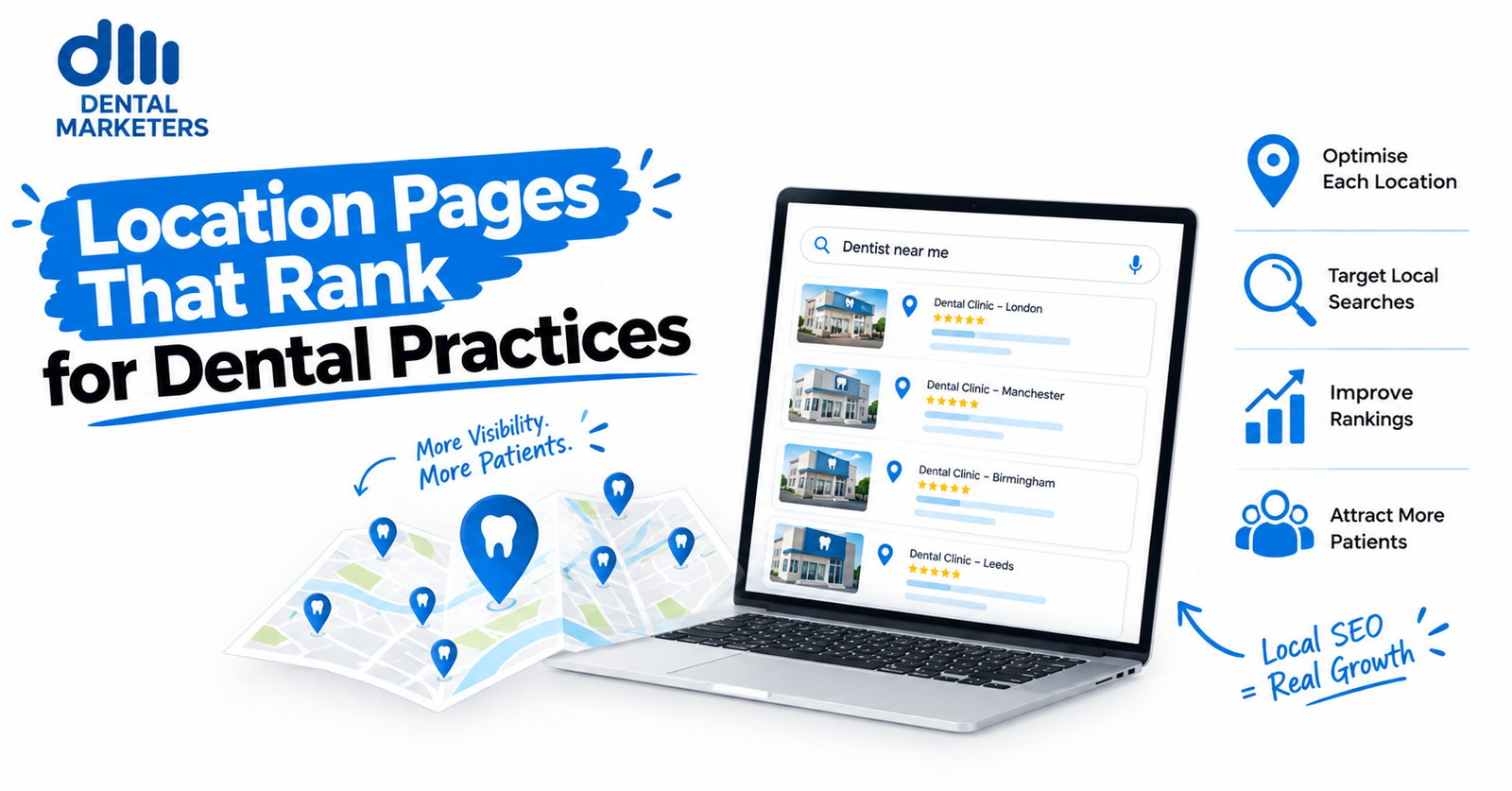
Create hyper-local pages for surrounding areas. If patients travel from nearby towns, build a dedicated landing page for each of those communities. Write unique content for each page. Reference local landmarks or neighbourhoods. Do not copy and paste — Google will penalise duplicate content.
Add schema markup. Schema is a small piece of code that helps Google understand your business. For dental practices, the most important types are Dentist, LocalBusiness, OpeningHoursSpecification, and FAQPage. These help Google show rich results with your hours, star rating, and FAQs directly in the search results.
4. Reviews — The Trust Signal That Drives Both Rankings and Bookings
Reviews are the backbone of your online reputation. They influence both your visibility in local search and whether a patient chooses you once they find you.
An overwhelming 98% of patients read online reviews before choosing a healthcare provider. Additionally, Google uses review volume and sentiment as a ranking factor in the Local Pack.
Build a proactive review system. Do not wait for reviews to happen organically. Set up an automated system that sends a review request by text or email within a few hours of a completed appointment. Make it a direct link to your Google review page — the fewer steps a patient has to take, the more likely they are to leave a review.
Respond to every single review. Responding to positive reviews shows appreciation and builds loyalty. Responding to negative reviews — professionally and empathetically — shows potential patients that you take concerns seriously. A thoughtful response to a complaint often builds more trust than a dozen five-star reviews.
Train your team. Your dental nurses and receptionists are on the front line. When they genuinely connect with patients, reviews happen naturally. Brief the whole team on why reviews matter and how patients can leave them easily.
The Practice Manager’s Weekly SEO Checklist
Practice managers are often the ones executing the strategy while the principal dentist focuses on patient care. Therefore, here is a realistic weekly routine that takes under three hours:
- Monday (15 min): Check Google Business Profile for new reviews. Respond to any reviews from the past week.
- Tuesday (30 min): Publish a Google Post — an offer, tip, or service highlight.
- Wednesday (30 min): Check your local rankings for five to ten key search terms using a free tool like Google Search Console.
- Thursday (45 min): Work on one piece of content — a service page update, a blog post, or a new FAQ.
- Friday (30 min): Review new patient enquiries and note which ones came from online search. Track this monthly to measure ROI.
Common Mistakes That Hold Dental Practices Back
Even well-run practices make these errors. Fortunately, they are easy to fix once you spot them.
Ignoring the Google Business Profile. Claiming it and forgetting it is almost worse than not claiming it. Google rewards active, updated profiles.
Targeting the wrong keywords. “Dentist” alone is too broad. Target specific, intent-rich phrases like “emergency dentist [city],” “Invisalign provider near me,” and “children’s dentist accepting new patients.”
No online booking. A patient searching at 10 PM cannot call you. If you do not offer online booking, you lose that lead. An online scheduler is one of the highest-impact investments a practice can make.
Slow or mobile-unfriendly website. More than 63% of Google searches happen on mobile. If your site loads slowly or is hard to navigate on a phone, patients will leave — and Google will rank you lower as a result.
No seasonal strategy. Back-to-school checkups in August, New Year teeth whitening in January, and Christmas smile makeovers in December — these seasonal content opportunities are almost entirely ignored by competitors. Consequently, they are wide open for you to own.
How Long Does Local SEO Take to Work?
This is the question every practice manager asks. The honest answer is: initial results appear within three to four months. Dominant, page-one rankings for competitive terms like “cosmetic dentist [city]” typically take six to twelve months of consistent effort.
However, the payoff is significant. Unlike paid ads that stop the moment you stop paying, local SEO builds compound momentum. The work you do today continues to attract patients for years.
Ready to Take Your Practice to the Next Level?
Local SEO is not a one-time project. It is an ongoing system — and the practices that treat it that way are the ones filling their schedules with the right patients.
Work With Dental Marketers — The UK’s Specialist Dental SEO Agency
At Dental Marketers, we help practice managers and owners build dental practices that patients can actually find.
We understand that your time is spent on patient care, team management, and running a business. You should not have to become an SEO expert on top of all that.
That is why we do the work for you. From Google Business Profile optimisation and citation building to content strategy, review systems, and technical SEO — we handle everything. Every strategy we use is built specifically for dental practices and designed to comply with professional marketing standards.
The result? More new patients. More high-value treatments booked. And a practice that keeps growing — consistently and predictably.
👉 Discover how Dental Marketers can grow your practice → Unlock Your Practice’s Potential: Essential Dental SEO Strategies for 2026
Book your free dental SEO audit today. We will analyse your current local search visibility, compare it to your top three competitors, and show you exactly what needs to change — with no obligation.
Frequently Asked Questions
What is local SEO for dentists?
Local SEO helps your dental practice show up when nearby patients search for dental services on Google. It puts your practice in front of people who are ready to book.
How do I optimise my Google Business Profile?
Fill out every section completely. Add your services, upload quality photos, post weekly updates, and respond to every review. An active profile ranks higher.
How long does local SEO take to work?
You will see early results in 3 to 4 months. Competitive terms like “cosmetic dentist near me” typically take 6 to 12 months of consistent effort.
Do reviews really affect my local rankings?
Yes. Google uses review volume and star ratings as a ranking factor. More positive reviews mean better visibility and more patients choosing your practice.
Can a practice manager handle local SEO in-house?
Yes. Basic tasks like updating your Google Business Profile, posting weekly, and requesting reviews take under 3 hours per week and deliver strong results.