Most people do not book a dental appointment the first time they visit your website. In fact, the vast majority of visitors simply leave without taking any action. This is completely normal. However, it does not mean those visitors are gone for good. With Google remarketing for dentists, you can bring them back and turn interest into bookings.
In this guide, we will explain exactly what Google remarketing is, how it works for dental practices, and why it is one of the most overlooked yet highest-ROI strategies in dental marketing today.
What Is Google Remarketing?
Google remarketing is a type of online advertising. It targets people who have already visited your website. When someone visits your site and leaves without booking, Google can show them your adverts as they browse other websites, watch YouTube videos, or use apps.
Think of it as a gentle reminder. The person was interested once. So you remind them that you are still there. As a result, they are far more likely to come back and book than a stranger who has never heard of you.
For dental practices, this is especially powerful. People often search for a dentist, visit a few websites, and then get distracted. Dental remarketing ads keep your practice at the front of their mind until they are ready to take action.
How Does It Work? The Role of Pixel Tracking
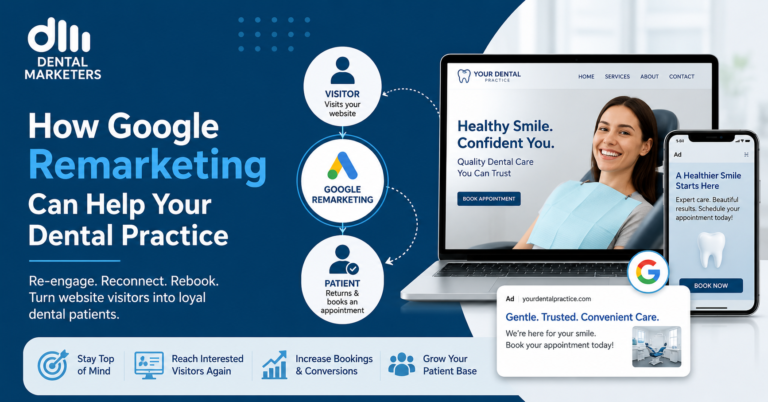
The technology behind remarketing is called a tracking pixel. A pixel is a tiny, invisible piece of code that you add to your website. When someone visits your site, the pixel fires and adds that person to a remarketing audience list inside your Google Ads account.
Here is how pixel tracking for dentists works step by step:
- A potential patient visits your website and views your dental implant page.
- The Google pixel fires and tags that visitor in a custom audience list.
- They leave your site without booking and browse the internet as normal.
- Your dental remarketing ads follow them across Google’s Display Network, YouTube, and partner sites.
This process is fully automated. Once you set it up, it runs in the background. Furthermore, it is highly targeted. You are not wasting money showing adverts to random people. Instead, you are reaching people who have already shown interest in your practice.
Why Is Dental Remarketing So Effective?
Traditional advertising casts a wide net. You pay to show adverts to thousands of people who may have no interest in your practice. Conversely, remarketing only targets people who have already visited your site. This makes it far more cost-effective.
Here are the key reasons why Google remarketing for dentists delivers such strong results:
Higher Conversion Rates
Warm audiences convert at much higher rates than cold ones. A person who has already visited your website is already aware of your practice. Therefore, it takes far less effort to persuade them to book. Dental remarketing ads speak to people who are already partway through their decision-making journey.
Lower Cost Per Click
Display remarketing adverts typically cost much less per click than standard search ads. Additionally, because your audience is pre-qualified, you waste far less of your budget on people who will never convert. This means a better return on investment for your practice.
Keeps Your Practice Top of Mind
People are busy. They often intend to book an appointment but simply forget. Remarketing solves this. Your practice appears in front of them repeatedly as they go about their day online. Consequently, when they are finally ready to book, your practice is the first one they think of.
Types of Google Remarketing Campaigns for Dental Practices
There are several types of dental remarketing ads you can run. Each one serves a slightly different purpose. Moreover, they can all be used together for maximum impact.
Standard Display Remarketing
This is the most common type. Your banner adverts appear on websites across Google’s Display Network. These are the image-based adverts you see in the sidebars and footers of websites. They are great for building brand awareness and keeping your practice visible.
Dynamic Remarketing
Dynamic dental remarketing ads automatically show the specific service a visitor looked at on your site. For example, if someone viewed your Invisalign page, they will see an advert specifically about Invisalign. This level of personalisation significantly increases click-through rates.
YouTube Remarketing
You can also remarket to past website visitors through YouTube video adverts. This is a particularly powerful format because video builds trust quickly. A short video showcasing your practice and team can be incredibly persuasive to someone who is still deciding where to book.
Search Remarketing (RLSA)
Remarketing Lists for Search Ads (RLSA) let you adjust your search ad bids for people who have previously visited your site. In other words, when a past visitor searches for ‘dentist near me’ again, you can bid higher to make sure your advert appears at the top. This is an extremely effective tactic for capturing high-intent searchers.
How to Set Up Google Remarketing for Your Dental Practice
Getting started with google remarketing dentists is more straightforward than many people assume. Here is a simple overview of the key steps involved.
Step 1 — Install the Google Tag on Your Website
First, you need to install the Google Ads global site tag (or use Google Tag Manager). This is the pixel tracking code that collects your audience data. Without this, remarketing cannot work. Your web developer can add this in a matter of minutes.
Step 2 — Build Your Audience Lists
Next, you create audience lists inside Google Ads. For example, you might create separate lists for people who visited your dental implants page, your teeth whitening page, or your general contact page. Then, you can show tailored dental remarketing ads to each group.
Step 3 — Create Your Adverts
Then, you design your adverts. Google’s responsive display ads make this easy. You upload several headlines, descriptions, and images. Google then automatically combines these into the best-performing format for each placement. Make sure your adverts are clear, professional, and include a strong call to action such as ‘Book Your Free Consultation Today’.
Step 4 — Set Your Budget and Launch
Finally, you set your daily budget and launch your campaigns. You can start small. Even a modest budget can generate strong results because you are targeting such a highly relevant audience. Furthermore, you can adjust your spend at any time based on performance.
A Note on GDPR and Cookie Consent for UK Dental Practices
If your practice is based in the UK, you must ensure your remarketing activity is GDPR-compliant. This means you need to have a proper cookie consent banner on your website. Visitors must actively agree to tracking before the pixel fires. Additionally, your privacy policy must clearly explain how you use remarketing data.
This is not something to skip. Non-compliance can result in fines from the ICO. However, the good news is that setting up a compliant cookie consent solution is straightforward and does not significantly affect your remarketing performance.
How to Measure the Success of Your Dental Remarketing Ads
As with any marketing activity, you need to track your results. Google Ads provides detailed reporting for all your remarketing campaigns. The key metrics to monitor include:
- Click-through rate (CTR): How often people click your advert when they see it.
- Conversion rate: How many clicks result in a booking or enquiry.
- Cost per conversion: How much you spend to acquire each new patient lead.
- Return on ad spend (ROAS): The revenue generated for every pound spent on ads.
By reviewing these metrics regularly, you can refine your campaigns and improve results over time. Moreover, you can pause adverts that are underperforming and increase budgets on those that are working well.
Frequently Asked Questions
How long does it take to see results from dental remarketing?
You can start seeing results within days of launching your campaigns. However, it typically takes 4–8 weeks to gather enough data to optimise your campaigns properly.
How much should a dental practice spend on remarketing?
You can start with as little as £5–£10 per day. Because the audience is so targeted, even a small budget can deliver meaningful results. As your practice grows, you can scale up your spend accordingly.
Is remarketing suitable for NHS dental practices?
Yes, absolutely. Whether you offer NHS or private dental treatments, remarketing can help you attract more patients. It is especially effective for practices offering private treatments such as implants, Invisalign, or cosmetic dentistry, where the patient decision-making process takes longer.
Ready to Bring More Patients Back to Your Practice?
Google remarketing is one of the most cost-effective tools available to dental practices today. It targets people who are already interested in your services, costs less than traditional advertising, and delivers a higher return on investment. Yet it remains one of the most overlooked strategies in dental marketing.
At Dental Marketers, we are a dedicated UK dental marketing agency specialising in helping dental practices get more from their digital marketing. From setting up pixel tracking to building high-converting dental remarketing ad campaigns, our team handles everything so you can focus on your patients.
Get in touch with Dental Marketers today to find out how we can help your practice grow with Google remarketing.
Further Reading: